Introduction
There’s a threshold every failing drain field crosses; on one side, it’s a repair; on the other, it’s a full excavation and a bill that redefines the word expensive. If sewage backs up into your sinks, pools in your yard, or makes you call a professional right away, it’s usually too late to get help at a reasonable price. What started as a simple septic drain field repair turns into a big digging job. The drain field replacement cost lands like a shock. And the most frustrating part? It was preventable. At Dirty Deeds Septic, our team has seen this story play out too many times across Western Washington, and we want to change it.
This blog breaks down everything you need to know about drain field repair vs. replacement in 2026: what actually causes a drain field to fail, the real signs of a failing drain field, what modern restoration looks like, and how professionals choose which way to go. Read this before making any decision.
How a Drain Field Is Supposed to Work
Your home’s wastewater goes to the septic tank, where it separates by weight. Solids sink, grease floats, and liquid waste flows out into the drain field, which is a network of pipes buried in gravel trenches underground. The effluent then seeps into the soil around it, where microorganisms filter out pathogens, nutrients, and contaminants before the water goes back to the groundwater table.
There is more to the drain field than just pipes and gravel. It is a living biological system. The soil is an active participant, and its health determines how long your drain field performs.
Early Warning Signs Your Drain Field Is in Trouble
It’s not common for all of these symptoms to show up at the same time. They usually build up over time, which is why so many homeowners don’t notice them until the damage is bad.
- Slow drainage across multiple fixtures simultaneously
- Sewage odors indoors or near the drain field area
- Gurgling sounds from toilets or drains when water runs elsewhere
- Soggy, spongy ground above the drain field, even in dry weather
- Unusually green, fast-growing grass over the field lines
Each of these is a signal that effluent is not absorbing as it should. Ignoring them doesn’t pause the failure; it accelerates it.
Why Drain Fields Fail Years Before Their Expected Lifespan
A drain field rated for 20–25 years can fail in 10. Here’s what the industry rarely tells you.
The most common cause of early failure is biomat overgrowth. Biomat is a natural, slimy microbial layer that forms where effluent meets soil. It is supposed to be there and, in healthy amounts, it filters out germs. Things go wrong when it gets too thick. When the septic tank is too full or hasn’t been pumped in a while, too many solids and grease get to the drain field and feed the biomat beyond its normal range. It turns into a wall that can’t be broken through. Effluent stops absorbing. The field backs up.
Making it worse: aerobic bacteria living just outside the trench walls naturally regulate biomat growth. But those aerobic colonies die when the soil gets too wet or flooded. Biomats grow without them, leaving behind sulfide compounds that permanently seal soil pores. At that point, a pump-out won’t help.
Harsh chemical drain cleaners quietly contribute to the same problem. They strip out the beneficial bacteria your system depends on to break down waste. Without that bacterial balance, organic matter accumulates faster, biomat thickens ahead of schedule, and the field moves toward failure sooner than it ever should have.
When Repair Is a Smart Option, And When It Isn’t
This is the question we address on every service call. Can a leach field be repaired? Yes, but only when the right conditions are present.
Repair works when:
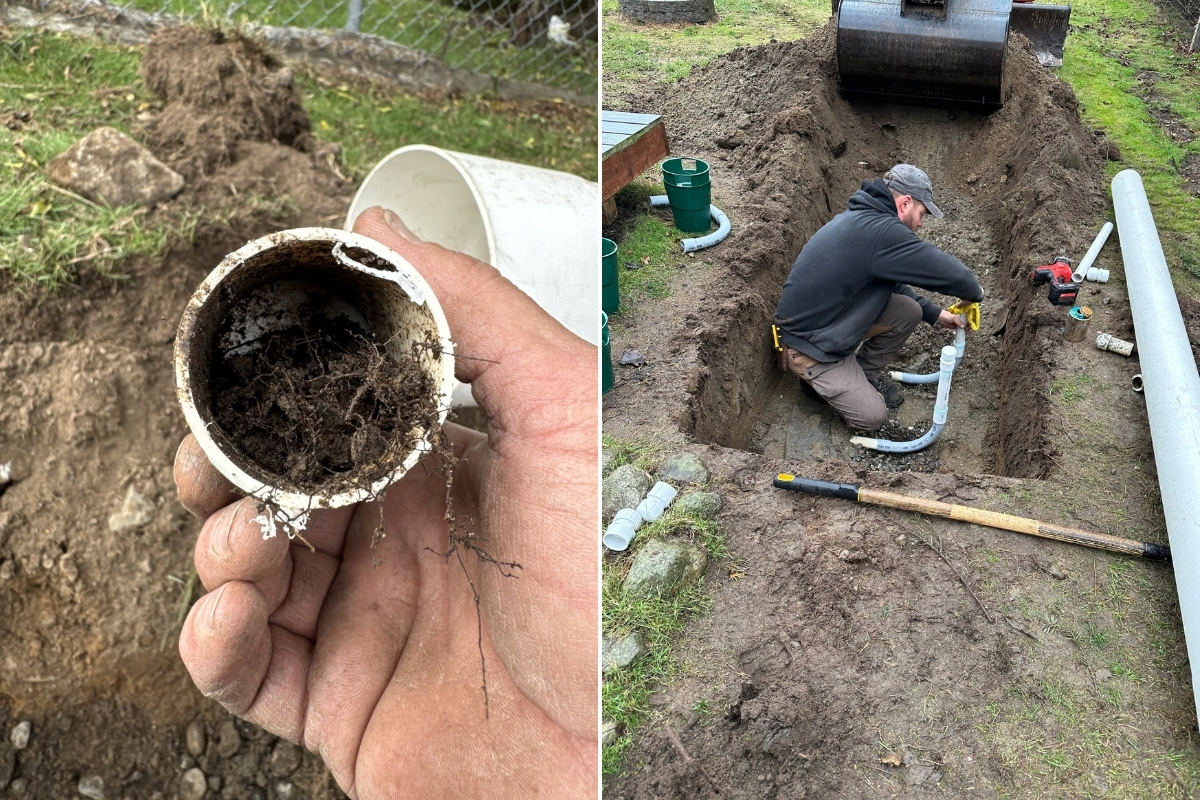
- Damage is isolated to one section of pipe (root intrusion, a small collapse, a cracked lateral)
- Biomat buildup is caught early, before full soil saturation
- The distribution box is damaged or uneven, overloading one part of the field
- The system is under 15 years old and has been maintained with regular pumping
When to replace a septic drain field:
- Soil is fully saturated and no longer capable of absorbing effluent
- The system is 20+ years old with a history of recurring problems
- Failure is widespread across the entire field, not localized
- Root intrusion has compromised multiple sections simultaneously
- The original installation was undersized or incorrectly engineered
The distinction is very important. Trying to fix a field that is completely saturated doesn’t just fail; it also costs more and takes longer.
Key Factors Pros Use to Decide Repair vs. Replacement
Drain field inspection and testing is the only reliable way to know which direction to go. At Dirty Deeds Septic, our technicians don’t guess. We assess.
| Factor | Lean Toward Repair | Lean Toward Replacement |
| System age | Under 15 years | 20+ years |
| Damage scope | Localized | System-wide |
| Soil absorption | Partially functional | Fully saturated |
| Maintenance history | Regular pumping | Consistently neglected |
| Prior repairs | First occurrence | Recurring failures |
With camera inspection, we can see right into the distribution lines and figure out exactly where the problem starts, so you don’t have to pay for guesswork. This also helps us determine whether septic system repair or replacement is the financially sound decision for your specific property.
Understanding Modern Repair and Restoration Options
Not every failing drain field needs to be dug up. Modern restoration has changed what’s possible.
The drain field restoration methods available today are significantly more advanced than those that existed a decade ago. Dirty Deeds Septic is one of only a few companies in the Pacific Northwest that has invested in the tools and training needed to fix drain fields instead of just suggesting that they be replaced.
Current restoration approaches include:
- Soil aeration/fracturing: Injects air into compacted soil to restore permeability and reintroduce oxygen, reviving aerobic bacteria populations
- Hydro-jetting: High-pressure clearing of biomat, grease, and debris inside distribution lines
- Spot pipe repair: Targeted replacement of a damaged section without disturbing the full field
- Distribution box repair: Corrects uneven effluent flow that’s overloading one area of the field
These methods can extend the life of a septic drain field by years when applied at the right stage. The window for restoration closes when the soil becomes permanently saturated, which is why timing is so important.
What Drain Field Replacement Actually Involves
When replacement is the right answer, there are no shortcuts. The process includes percolation testing to evaluate the soil’s absorption rate, permitting (required before any excavation begins), full removal of the failed system, and installation of properly engineered replacement lines.
Contaminated soil may need to be removed and replaced entirely. Final grading and site restoration complete the process.
The biggest part of the total cost is labor. But cutting costs on this project won’t save you money. A drain field that isn’t installed correctly fails faster than the one it replaced.
A Simple Decision Framework for Homeowners
| What You’re Seeing | Most Likely Next Step |
| Slow drains, mild odors, system under 15 years | Professional inspection first |
| Soggy yard patches, system 10–18 years old | Inspection + likely repair |
| Sewage surfacing, system 20+ years | Replacement is probable |
| Recurring failures after prior repairs | Full evaluation for replacement |
This table is not a diagnosis; it is a guide.Drain field inspection and testing by a licensed professional is the only way to confirm the path forward.
The Right Call Starts With the Right Assessment
Understanding drain field repair vs. replacement comes down to one thing: you need to know the real state of your soil and system, not just what you think is wrong with it. Biomat, soil saturation, pipe damage, and bacterial imbalance each require a different response. Taking action early almost always gives you more choices, costs less, and causes less damage to your property.
At Dirty Deeds Septic, we serve homeowners across Oak Harbor, Coupeville, WA, Anacortes, WA, and throughout Whidbey Island, WA with licensed inspections, advanced diagnostic tools, and repair capabilities that most companies in this region simply don’t offer. We explain every finding and every option to you because a homeowner who knows more makes better choices.
Don’t wait for sewage in your yard to make the call. Contact Dirty Deeds Septic today at (833) 784-6592. Our team is available 24/7, and we’ll help you figure out exactly where your system stands before it costs you more than it should.